Table of Contents
Digital Out-Of-Home advertising — DOOH — has emerged as one of the most sophisticated and rapidly growing channels in the Indian advertising landscape. As brands search for alternatives to digital platforms plagued by ad fraud, diminishing organic reach, and consumer ad-blocking, DOOH delivers something online advertising fundamentally cannot: guaranteed physical presence in the real world. This comprehensive guide covers the strategic principles, measurement frameworks, and creative best practices that drive real, measurable ROI from DOOH campaigns in Kerala and across South India.
What Exactly Is DOOH and Why Is It Surging?
Digital Out-Of-Home advertising encompasses any digitally controlled display placed in public spaces — from massive electronic billboards on national highways to digital menu boards in restaurant chains, digital signage in shopping malls, and mobile LED van networks operating across cities and towns.
The DOOH market in India is projected to grow from approximately Rs. 2,000 crore in 2023 to over Rs. 4,500 crore by 2027, driven by rapid infrastructure development, the proliferation of LED display technology, and growing advertiser sophistication. In Kerala specifically, the combination of high urbanisation rates, strong road infrastructure, and an unusually media-aware consumer base makes DOOH a particularly powerful channel.
The surge in DOOH investment is directly correlated with worsening performance metrics in digital advertising. Average click-through rates for display advertising have fallen to below 0.1%. Ad fraud — where automated bots generate false impressions and clicks — consumes an estimated 20 to 30% of digital advertising budgets globally. Ad blockers are now installed on over 30% of internet-connected devices. Against this deteriorating online landscape, DOOH's physical, unskippable presence in the real world looks increasingly attractive to brand managers and media buyers.
The Seven Strategic Principles of High-ROI DOOH
1. Audience-First Location Selection
The fundamental principle of OOH planning has always been location selection, but DOOH elevates this from an art to a data science. Rather than simply choosing the highest-traffic junctions, sophisticated DOOH planning overlays multiple data layers: traffic volume, demographic composition of the passing audience, the time-of-day audience profile, proximity to relevant points of interest (your stores, competitor stores, catchment area boundaries), and competitive share of voice in each location.
For a bank launching a fixed deposit product targeting retirees and pre-retirement professionals in Thiruvananthapuram, the optimal DOOH locations might be entirely different from those a quick-service restaurant brand would select for a student-targeting burger campaign. Audience-first location selection ensures your budget is concentrated where it generates qualified impressions — not just raw impressions.
2. Dynamic, Contextual Creative
The most powerful capability that distinguishes DOOH from static OOH is dynamic content management — the ability to change what is displayed based on real-world contextual variables without any physical intervention.
Contextual triggers that sophisticated DOOH campaigns in India are now routinely using include: time of day (breakfast promotions at 7–10 AM, dinner promotions at 6–9 PM), day of week (weekday professional messaging vs. weekend family messaging), real-time weather conditions (hot beverage promotions during rain, ice cream promotions above 35°C), live sports scores or match status (beer and snack promotions during cricket match intervals), and hyper-local event proximity (special messages for displays near a running festival or convention).
Each of these contextual triggers increases the relevance of the advertising message to the viewer's current mindset, directly improving message recall and purchase intent. Research by Nielsen India shows contextually relevant advertising generates 20 to 30% higher recall scores than non-contextual equivalents.
3. Dayparting for Efficiency
Dayparting — scheduling your creative to display only during specific time windows — is fundamental to DOOH budget efficiency. A brand targeting working professionals has a dramatically different optimal window than one targeting housewives or university students. A DOOH campaign that runs at full budget intensity 24 hours a day is almost certainly wasting a significant portion of its investment on low-value impressions during off-target hours.
Professional DOOH campaigns in Kerala routinely define 3 to 6 daypart windows aligned with target audience movement patterns, concentrating display frequency and creative attention during peak relevance hours and reducing spend (or switching to different audience-appropriate creative) during off-peak periods.
4. Frequency Management
Effective frequency — the number of times a target audience member must be exposed to an advertising message before it achieves meaningful recall and purchase intent influence — varies by category and message complexity. Brand awareness campaigns for simple-message products may achieve effective recall at 3 to 5 exposures. Complex products requiring education or consideration (financial products, healthcare treatments, high-consideration electronics) may require 7 to 12 exposures to drive measurable intent shift.
Well-planned DOOH campaigns use audience movement data to estimate the weekly frequency achieved at each location for the target demographic, then adjust the number of panels, location distribution, and campaign duration to hit the desired frequency target within the media budget.
5. Mobile Retargeting Integration
This is where DOOH transcends its traditional measurement limitations entirely. By installing geofences around DOOH display locations, mobile advertising platforms can identify device audiences who have been physically present near your OOH display and subsequently serve those same users targeted mobile advertising.
This "OOH priming and mobile closing" strategy is perhaps the most powerful evolution in out-of-home advertising methodology. The DOOH exposure creates brand familiarity and primes the audience for a considered response. The subsequent mobile retargeting, served when the user is on their phone and perhaps actively browsing product categories, converts the primed awareness into direct engagement and purchase-intent actions.
Studies consistently show that campaigns combining OOH and mobile retargeting generate 2 to 4 times higher engagement rates on the mobile component versus mobile-only campaigns with no OOH priming — a direct, measurable ROI multiplier for the entire integrated campaign investment.
6. Creative Length Optimisation
DOOH creative follows the 1:3 rule of OOH advertising: your core message should be comprehensible within one-third of the average exposure time at each location. For a moving vehicle exposure of 8 seconds, the message must land within 2.5 seconds. For a stationary location with an average dwell time of 30 seconds, you have 10 seconds to make your primary impression. Design for the one-third scenario; anything additional is a bonus.
7. Multi-Format Synergy
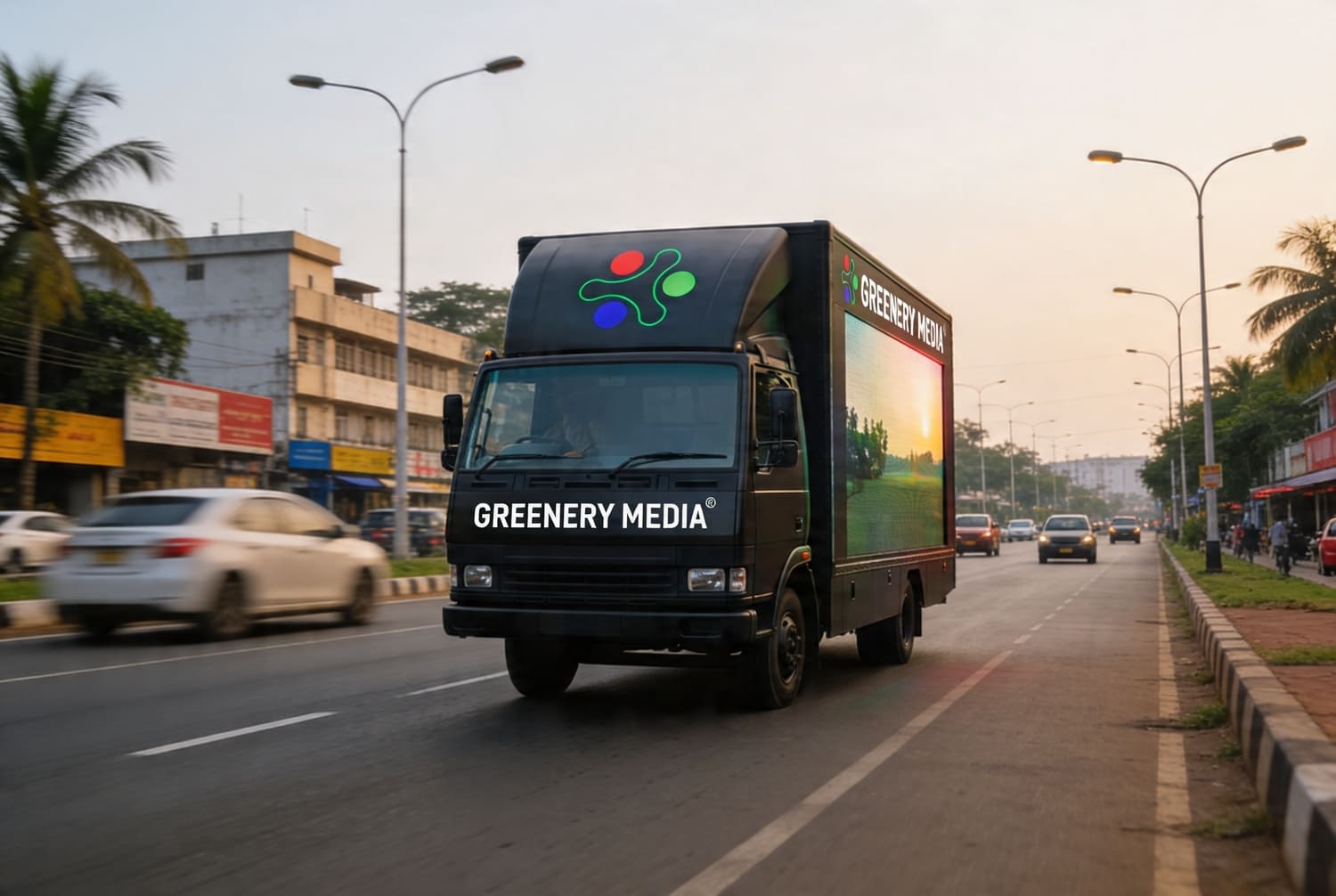
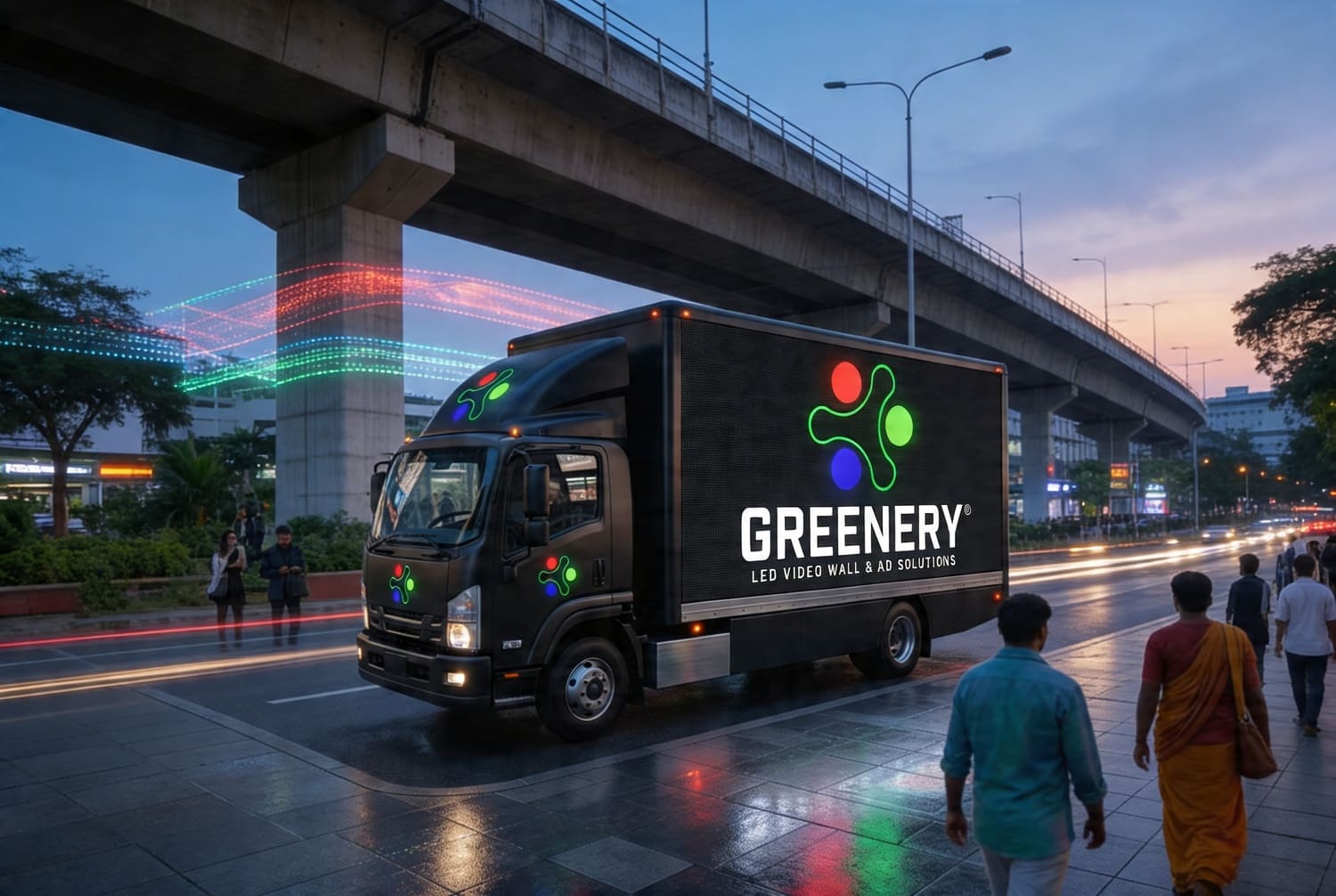
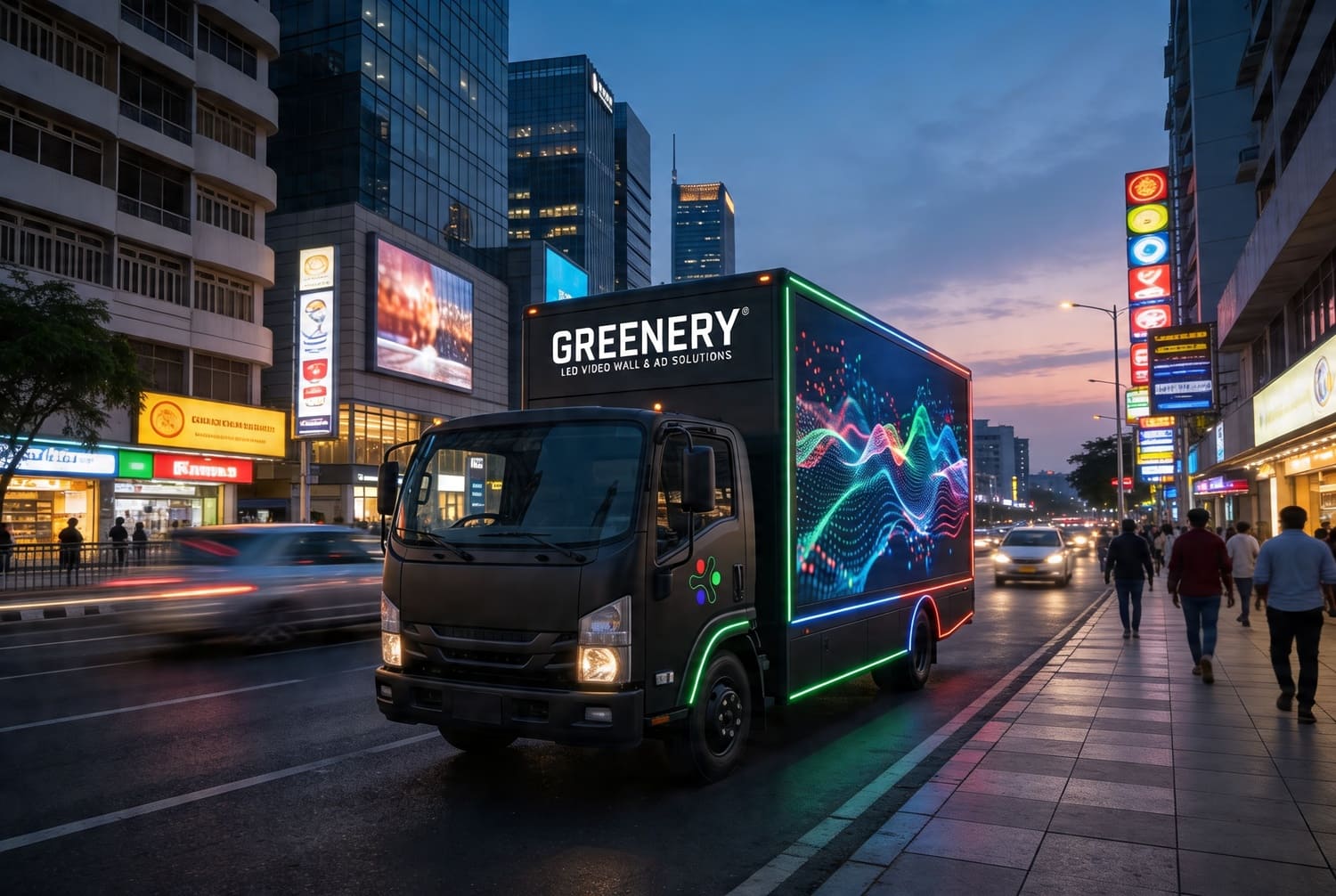
The most effective DOOH strategies in South India in 2026 use multiple formats in a coordinated architecture: large-format highway digitals for mass reach and brand building; mid-format street-level municipal displays for neighbourhood-level frequency; mobile LED van networks for dynamic, targeted local penetration; and mall/retail digital screens for close-proximity conversion at the point of purchase consideration. Each format serves a different role in the purchase journey funnel, and budgeting across all four, rather than concentrating everything in one format, delivers superior combined ROI.
Measuring DOOH ROI: A Practical Framework
The measurement revolution in DOOH is ongoing, and the tools available to advertisers in India in 2025 are substantially more sophisticated than even three years ago.
Reach and Frequency Measurement
The foundation of any DOOH measurement framework is reach (the number of unique target audience members exposed to the campaign at least once) and frequency (the average number of times each reached individual was exposed). These metrics are now calculated by professional providers using anonymised mobile device location data aggregated from permission-based datasets, traffic flow analysis from municipal road sensors, and validated pedestrian counting systems at key locations.
Brand Lift Studies
Pre- and post-campaign brand lift studies — conducted via targeted mobile surveys among audiences geofenced around DOOH locations — directly measure the change in brand awareness, message association, and purchase intent attributable to the DOOH campaign. These studies provide the most direct evidence of advertising effectiveness and are increasingly used by sophisticated DOOH advertisers in Kerala to justify and optimise their OOH investments.
Campaign-Specific Tracking
Dedicated phone numbers, unique QR codes, and campaign-specific landing page URLs assigned exclusively to DOOH creative allow direct measurement of conversions generated by outdoor exposure. While these tools capture only a subset of the response generated (many people respond to OOH exposure days or weeks later through organic search rather than an immediate scan or call), they provide valuable directional evidence of campaign effectiveness and help build the case for continued DOOH investment.
The Kerala DOOH Opportunity
Kerala presents a uniquely compelling DOOH opportunity for several structural reasons. With an urban population of over 16 million concentrated in a relatively narrow coastal strip, the density of potential impressions per kilometre of roadside media is among the highest in India. Kerala's vehicle ownership rates — particularly two-wheelers and private cars — create significant hours of daily commute exposure for the working population. And Kerala's cultural emphasis on education, media, and public discourse means that impactful, well-crafted public communications genuinely cut through.
For brands seeking to establish themselves in the Kerala market or to maintain competitive share of voice in one of South India's most competitive consumer markets, DOOH through Greenery Media's extensive network of mobile and static digital displays represents one of the most cost-effective and brand-safe media investments available.
Conclusion
Digital Out-Of-Home advertising has grown from a supplementary media format into a primary brand-building and conversion-driving channel for sophisticated advertisers across South India. When planned with rigorous audience data, dynamic creative strategy, integrated mobile amplification, and robust measurement frameworks, DOOH consistently delivers exceptional brand ROI. Contact Greenery Media's planning team today to design a DOOH strategy tailored to your brand's objectives and the unique media landscape of Kerala.
Building a Long-Term DOOH Media Strategy
The brands generating the highest DOOH ROI in Kerala are not those running individual campaign bursts — they are those that have built sustained, year-round DOOH media strategies with consistent presence across key locations, punctuated by intensified campaign periods aligned with product launches, seasonal peaks, and competitive response requirements.
Annual DOOH media planning offers several advantages over campaign-by-campaign booking. Consistent brand presence at key locations builds cumulative familiarity that makes individual campaign messages far more readily receivable by the audience. Long-term media partnerships with DOOH providers typically offer preferred pricing and priority access to premium locations. And integrated annual planning allows campaign budgets to be aligned with media consumption patterns — concentrating spending in the festive season while maintaining base-level visibility year-round.
For brands entering the Kerala market for the first time, a phased DOOH strategy often works best: an initial awareness phase concentrating on the highest-traffic locations in the top three cities to build baseline brand recognition, followed by a geographic expansion phase into secondary cities and mobile LED van coverage of rural corridors, and finally a conversion-focused phase that uses hyper-local point-of-sale proximity targeting to drive direct purchase consideration.
DOOH and the Green Advertising Opportunity
For brands with published environmental sustainability commitments, DOOH offers a genuinely compelling advantage versus traditional OOH: near-zero material waste. No vinyl flex is printed, transported, installed, or landfilled. No paper posters are produced by the thousands. No paint is consumed or requires hazardous waste disposal. A single LED billboard installation can serve thousands of campaigns over its operational lifetime, with each content update delivered as a digital file rather than a physical material intervention.
This environmental credential of DOOH is increasingly being incorporated into corporate advertising budget justification frameworks — particularly for brands with net-zero or ESG reporting requirements — as another dimension of the superior ROI case for outdoor LED versus traditional print OOH. Talk to our team today about how Greenery Media can support your brand's sustainable advertising strategy in Kerala.
Building a Long-Term DOOH Media Strategy
The brands generating the highest DOOH ROI in Kerala are not those running individual campaign bursts — they are those that have built sustained, year-round DOOH media strategies with consistent presence across key locations, punctuated by intensified campaign periods aligned with product launches, seasonal peaks, and competitive response requirements.
Annual DOOH media planning offers several advantages over campaign-by-campaign booking. Consistent brand presence at key locations builds cumulative familiarity that makes individual campaign messages far more readily receivable by the audience. Long-term media partnerships with DOOH providers typically offer preferred pricing and priority access to premium locations. And integrated annual planning allows campaign budgets to be aligned with media consumption patterns — concentrating spending in the festive season while maintaining base-level visibility year-round.
For brands entering the Kerala market for the first time, a phased DOOH strategy often works best: an initial awareness phase concentrating on the highest-traffic locations in the top three cities to build baseline brand recognition, followed by a geographic expansion phase into secondary cities and mobile LED van coverage of rural corridors, and finally a conversion-focused phase that uses hyper-local point-of-sale proximity targeting to drive direct purchase consideration.
DOOH and the Green Advertising Opportunity
For brands with published environmental sustainability commitments, DOOH offers a genuinely compelling advantage versus traditional OOH: near-zero material waste. No vinyl flex is printed, transported, installed, or landfilled. No paper posters are produced by the thousands. No paint is consumed or requires hazardous waste disposal. A single LED billboard installation can serve thousands of campaigns over its operational lifetime, with each content update delivered as a digital file rather than a physical material intervention.
This environmental credential of DOOH is increasingly being incorporated into corporate advertising budget justification frameworks — particularly for brands with net-zero or ESG reporting requirements — as another dimension of the superior ROI case for outdoor LED versus traditional print OOH. Talk to our team today about how Greenery Media can support your brand's sustainable advertising strategy in Kerala.
Ready to Elevate Your Campaign?
Speak with our OOH media experts today. We provide full-service LED display rentals across Kerala and beyond.