Table of Contents
The stage backdrop has been the most visible element of event design since the era of painted theatrical scenery. From stretched flex banners to projection screen fabrics, backdrop technology has evolved steadily — but no previous development has disrupted stage design as completely and irrevocably as the LED video wall. Today, the most impactful stages in Kerala's event industry — from grand corporate conferences in Kochi to state-level cultural festivals in Thiruvananthapuram — are built around dynamic, pixel-perfect LED canvases that transform not just how a stage looks, but what storytelling is possible within a live event context. This guide explores the technical artistry behind LED stage backdrops and provides event planners with a comprehensive framework for designing LED-powered visual experiences that create lasting memory.
The Death of the Flex Banner: An Industry Postmortem
To understand why LED video walls have so completely overtaken static backdrops, it helps to enumerate the specific, practical limitations of the printed flex banner that plagued event organisers for decades.
Single-use waste: Every flex banner is printed for one event and then typically discarded. For large-scale events deploying multiple backdrop sections, this represents substantial material cost and significant environmental waste — an increasingly uncomfortable contradiction for brands with published sustainability commitments.
Static imagery: A printed banner cannot move, transition, react to the speaker's presentation, or change atmosphere between program segments. The same image that greets delegates at the morning registration desk — perhaps the conference logo against a corporate navy background — must also serve as the backdrop for the evening gala dinner, creating an obvious aesthetic tension that no amount of lighting can fully resolve.
Print quality limitations: Even high-quality wide-format flex printing, viewed at close range and photographed under stage lighting, reveals its limitations. The rosette pattern of halftone printing, colour banding in large gradients, and the visible texture of the substrate all conspire to undermine the premium presentation quality that high-profile events demand.
Lead time and inflexibility: Changes to conference themes, speaker lineups, or sponsor listings discovered a week before the event face significant logistical and cost challenges to incorporate into already-printed flex banners. LED content can be updated right up until — or even during — an event.
LED video walls eliminate every one of these limitations simultaneously. The investment in LED rental or installation pays dividends not just in aesthetic quality but in operational flexibility, sustainability credentials, and the dramatic expansion of creative possibility.
The Architecture of a Professional LED Stage
Understanding how a professional LED stage backdrop is assembled — from the physical infrastructure to the content delivery system — helps event planners have informed conversations with their AV partners and make better decisions about configuration and scale.
Panel Selection and Resolution
For a conference stage backdrop viewed by an audience seated 8 to 25 metres from the stage front, a P3.9 indoor LED panel (3.9mm pixel pitch) delivers exceptional image quality. At this specification, a 10-metre wide by 4-metre tall wall — a configuration appropriate for a 1,000-person conference — provides a total resolution of approximately 2,564 x 1,025 pixels. This is sufficient for crisp HD video content, presentation slides at any standard font size, and live camera feeds.
For premium product launches, award ceremonies, or luxury brand events where the audience is closer to the screen (or where ultra-close-up branded detail shots will be part of the photography brief), upgrading to P2.9 or even P1.9 panels dramatically increases resolution density and produces genuinely magazine-quality imagery in the final photography product.
Structural Systems: Ground Support vs. Flown Rigs
LED stage backdrops are mounted using one of two primary structural approaches: ground-supported truss systems or flown (rigged from above) systems.
Ground-supported structures — where the LED cabinets are mounted on heavy-duty steel base frames, topped with vertical truss columns, and a horizontal header truss spans the full width — are suitable for venues without rigging points and give the technical team complete control over the installation without dependence on the venue's structural systems. These are the most commonly deployed configuration for temporary event backdrops in Kerala.
Flown systems, where the LED wall is suspended from rigging points in the venue ceiling, offer a cleaner aesthetic with no visible floor hardware, greater flexibility in stage layout, and the possibility of flying the screen to different heights during the event for dramatic reveal effects. Flown LED walls are the preferred configuration for large concert stages and theatre-style events in venues with certified rigging infrastructure.
The Media Server Ecosystem
The intelligence behind an LED stage backdrop is the media server — a specialised, high-performance computing platform that manages content playback, signal routing, real-time compositing, and output mapping to the LED wall.
Professional media servers (brands like Green Hippo, Resolume, and D3/Disguise are industry standards) can simultaneously manage multiple content channels: the main presentation input from the speaker's laptop, a live camera composite from stage cameras, pre-rendered motion graphics, and real-time generative visual effects — all blended, masked, and output to the LED wall as a single, seamlessly composed image. This multi-layer capability is what enables the striking visual storytelling you see at premium corporate events: a speaker standing in front of a live-rendered 3D brand animation that responds dynamically to the presentation narrative.
Creative Approaches: What to Display on Your LED Stage
The creative possibilities of an LED stage backdrop are limited primarily by imagination and content production budget. The following approaches, each suited to different event types and brand contexts, represent the most effective uses of this medium.
Ambient Brand Environments
The most common LED backdrop application is the ambient brand environment: a continuous, looping motion graphic that maintains brand presence throughout the event. This might be a slow-moving particle system in brand colours, a stylised landscape or abstract environment that references the company's industry sector, or an architectural rendition of the brand's design language animated into a living canvas.
The key to effective ambient environments is subtlety and restraint. The backdrop should enhance the speaker's presence, not compete with it. Motion should be slow, deliberate, and non-distracting — typically with full-screen animation speeds of no more than one complete composition cycle per 60 to 90 seconds.
Presentation-Integrated Displays
Many corporate conferences now use the LED wall as the primary presentation display, replacing the traditional combination of projector screen (for slides) plus printed backdrop. In this configuration, the media server simultaneously outputs the content from the presenter's slide deck, live camera feeds of the speaker, and lower-third graphic overlays — all as a single integrated composition across the full LED wall surface.
This approach requires careful aspect ratio planning: the full LED wall may be a wide-format 32:9 or even wider ratio, requiring the presentation designer to create slides sized for this enhanced canvas rather than standard 16:9 PowerPoint dimensions. Brief your content team about the wall dimensions early — ideally before presentation design begins — to ensure maximum creative use of the available canvas.
Immersive Environmental Storytelling
The most ambitious and visually spectacular LED stage applications use the full LED wall as a storytelling environment — using the technology not as a display surface but as a portal to another world. Technology product launches have placed speakers inside rendered digital factories, spacecraft interiors, or futuristic cities that exist only in the LED canvas behind them. Award ceremonies have placed recipients inside the landscapes that inspired the work being honoured. Brand narrative presentations have walked audiences through the brand's history as a visually rendered timeline environment.
These immersive approaches require significant content production investment and close collaboration between the creative team, the media server operator, and the LED wall provider. When executed well, they generate extraordinary social media shareability and create lasting audience memories that amplify the event's impact far beyond the day itself.
LED Stages for Kerala's Cultural and Religious Events
Beyond corporate events, LED stage technology has transformed Kerala's vibrant cultural event landscape. Temple festival stages, music and dance performance venues, cultural award ceremonies, and political gatherings have all increasingly embraced LED as the visual medium of choice for their public-facing stages.
The cultural context brings specific creative requirements. For classical performance stages, the LED backdrop must complement the form and costume of the performers without overwhelming the human artistry at the centre of the stage. This typically means ambient lighting-inspired content — slow architectural patterns derived from traditional Kerala architectural motifs, or subtle natural imagery of Kerala's landscapes — rather than the high-motion, high-saturation content appropriate for a corporate product launch.
Political and public event stages in Kerala have historically used bold, primary-colour graphic treatments that communicate unambiguously at distance. The move to LED enables these stages to incorporate video content — candidate speeches, testimonials, campaign films — in formats that would be impossible with printed static backdrops, dramatically increasing the communicative power of the stage environment.
Working With Your LED Provider: Keys to a Successful Collaboration
The best LED stage installations result from genuine creative and technical collaboration between the event producer and the LED provider. To make this collaboration successful:
- Engage your provider early. LED wall configurations influence every other element of stage design — set design, lighting plot, camera positions. The earlier your LED provider is involved, the better the integrated result.
- Share your photography brief. If you have a specific photography or cinematography vision for the event, share it with your LED provider. They can advise on refresh rate selection, brightness calibration, and content colour grading to optimise the display for camera capture.
- Plan a technical rehearsal. Never deploy LED stage content for the first time at the live event. A technical rehearsal — even a brief one-hour session — identifies integration issues between the presentation system and the LED wall before they occur in front of your audience.
- Brief your content designers on the output format. Provide your graphics team with the exact pixel dimensions of the wall configuration and any masking zones where content should appear faint or absent (behind speaker positions, for example).
Conclusion
The LED video wall has redefined what is possible on a stage. It is simultaneously a presentation system, a set design element, a storytelling canvas, and a brand communications platform. For events in Kerala — where visual grandeur and cultural expressiveness are deeply embedded in the tradition of public gathering — the LED stage backdrop offers an extraordinary tool for creating moments that audiences remember and share long after the event concludes. Greenery Media's engineering and creative teams are ready to help you design and execute an LED stage experience that exceeds your audience's expectations. Contact us to begin your consultation.
LED Backdrops for Trade Exhibitions and Brand Activations
Beyond formal corporate conference stages, LED backdrop technology is transforming a second major event category in Kerala's commercial calendar: trade exhibitions and consumer brand activations. Exhibition stands at industry trade shows in Kochi, Kozhikode, and Thrissur are increasingly incorporating LED display elements to stand out in the competitive, visually congested environment of multi-brand exhibition halls.
A well-designed LED exhibition presence — typically a configurable pixel tile system that frames the stand with dynamic brand content — creates a light beacon in a hall full of competing static printed stands and conventional roll-up banner backdrops. The motion and brightness draw visitor attention from across the hall, dramatically increasing the qualified footfall that an LED-integrated exhibition stand receives versus an equivalent stand with static print-only design.
For consumer-facing brand activations — pop-up installations at shopping centres, festival grounds, or other high-traffic venue contexts — LED display elements provide the visual scale and dynamism needed to create genuinely shareable moments. When visitors photograph themselves against a striking LED backdrop at a brand activation, they generate organic brand content that multiplies the reach far beyond the immediate physical audience.
The Future of LED Stage Technology
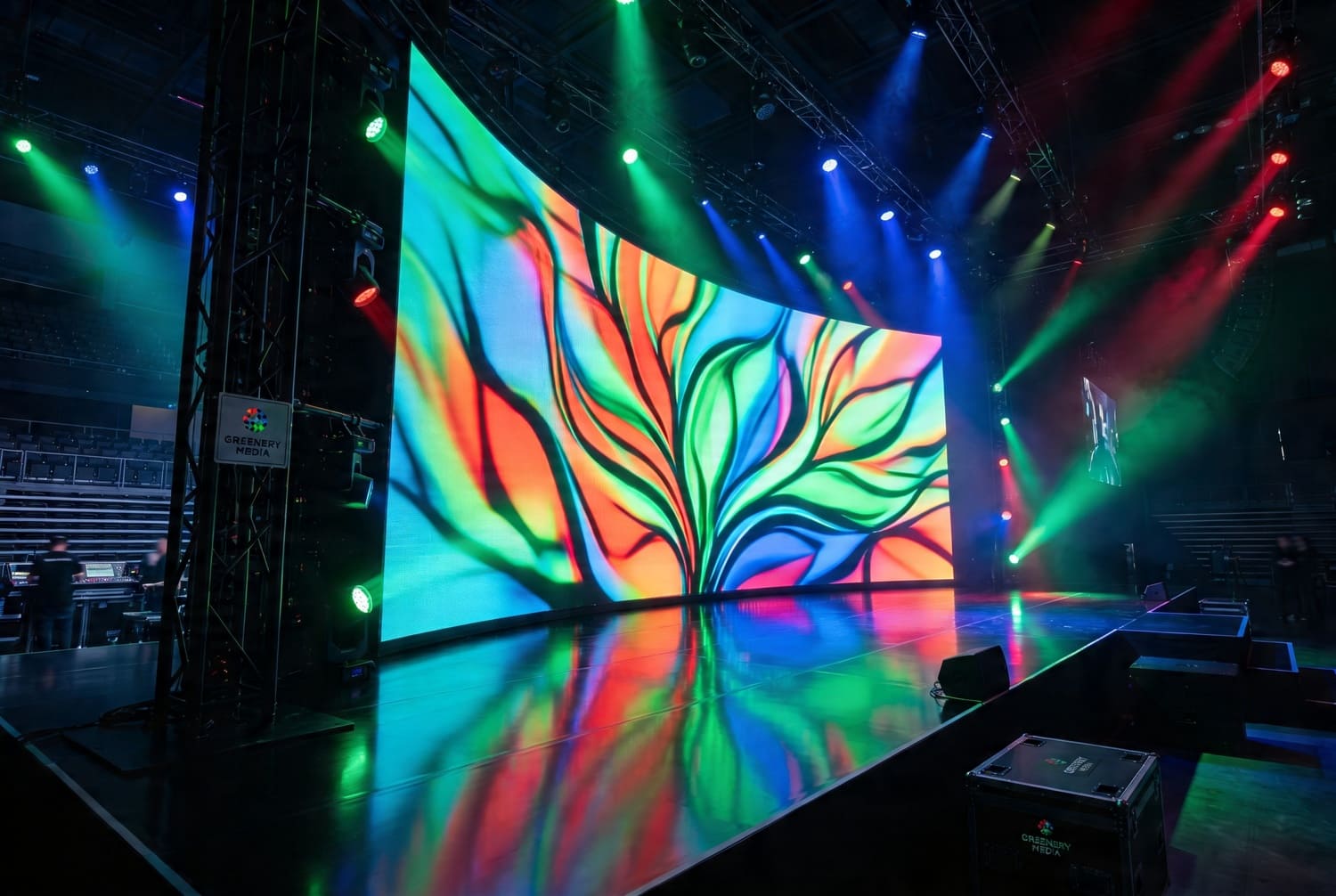
The evolution of LED stage display technology is accelerating. Fine-pitch panels continue to become more accessible in price as production volumes increase globally, making genuinely cinematic resolution backdrops available at event budgets that previously only afforded standard corporate-grade displays. Curved and non-planar LED configurations — where panels are manufactured with a slight convex or concave angle — are increasingly available for rental at premium event production houses, enabling stage environments with genuine architectural drama.
Interactive LED technologies — where the display responds to input from performers, audience members, or external data feeds in real time — are beginning to appear in cutting-edge performance art and corporate experience design contexts. As these technologies become more accessible and operationally practical for live event deployment, they will further expand the expressive possibilities of LED stage design for event producers in Kerala and across South India. Greenery Media is actively investing in next-generation LED inventory to ensure our clients always have access to the latest display technology for their most important events.
LED Backdrops for Trade Exhibitions and Brand Activations
Beyond formal corporate conference stages, LED backdrop technology is transforming a second major event category in Kerala's commercial calendar: trade exhibitions and consumer brand activations. Exhibition stands at industry trade shows in Kochi, Kozhikode, and Thrissur are increasingly incorporating LED display elements to stand out in the competitive, visually congested environment of multi-brand exhibition halls.
A well-designed LED exhibition presence — typically a configurable pixel tile system that frames the stand with dynamic brand content — creates a light beacon in a hall full of competing static printed stands and conventional roll-up banner backdrops. The motion and brightness draw visitor attention from across the hall, dramatically increasing the qualified footfall that an LED-integrated exhibition stand receives versus an equivalent stand with static print-only design.
For consumer-facing brand activations — pop-up installations at shopping centres, festival grounds, or other high-traffic venue contexts — LED display elements provide the visual scale and dynamism needed to create genuinely shareable moments. When visitors photograph themselves against a striking LED backdrop at a brand activation, they generate organic brand content that multiplies the reach far beyond the immediate physical audience.
The Future of LED Stage Technology
The evolution of LED stage display technology is accelerating. Fine-pitch panels continue to become more accessible in price as production volumes increase globally, making genuinely cinematic resolution backdrops available at event budgets that previously only afforded standard corporate-grade displays. Curved and non-planar LED configurations — where panels are manufactured with a slight convex or concave angle — are increasingly available for rental at premium event production houses, enabling stage environments with genuine architectural drama.
Interactive LED technologies — where the display responds to input from performers, audience members, or external data feeds in real time — are beginning to appear in cutting-edge performance art and corporate experience design contexts. As these technologies become more accessible and operationally practical for live event deployment, they will further expand the expressive possibilities of LED stage design for event producers in Kerala and across South India. Greenery Media is actively investing in next-generation LED inventory to ensure our clients always have access to the latest display technology for their most important events.
Ready to Elevate Your Campaign?
Speak with our OOH media experts today. We provide full-service LED display rentals across Kerala and beyond.