Table of Contents
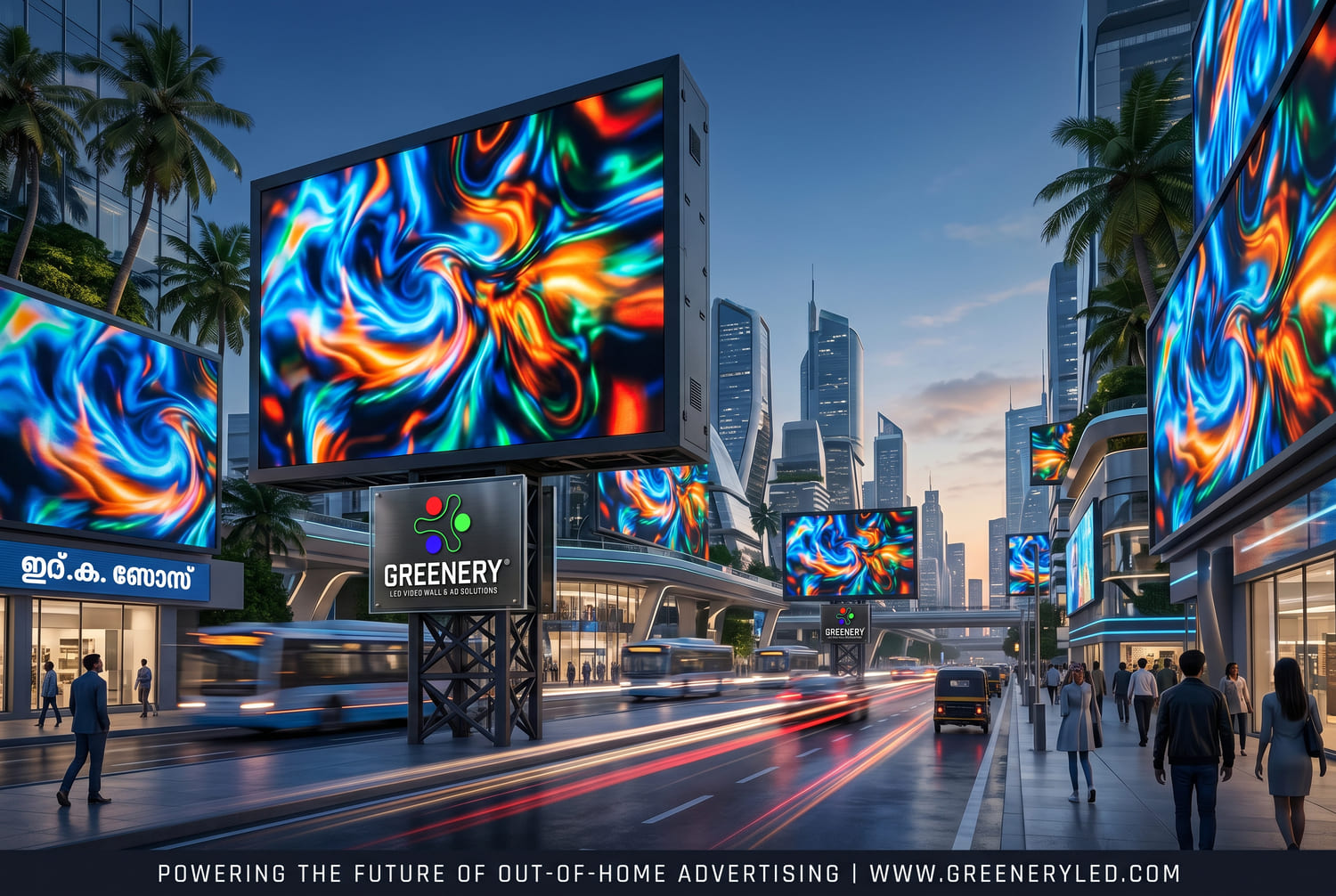
Outdoor advertising has been a cornerstone of brand-building strategy for over a century — and yet it has never been more powerful, more measurable, or more visually arresting than it is today. The arrival of outdoor LED video wall technology has fundamentally transformed what Out-Of-Home advertising can achieve, enabling dynamic, high-brightness, full-motion visual campaigns that command attention on Kerala's busiest streets, highways, and public spaces. This comprehensive guide examines why outdoor LED video walls are not merely the future of OOH advertising — they are already its definitive present.
The Decline of Static OOH and the Rise of DOOH
Static flex hoardings and painted billboards dominated outdoor advertising in Kerala for generations. While they remain operational across the state, their strategic effectiveness is in sustained decline — and the reasons are structural rather than cyclical.
Consumer attention patterns have fundamentally changed. In an era where every individual carries a smartphone delivering a continuous stream of motion, colour, and dynamic media, the human brain has evolved new filtering mechanisms specifically designed to screen out static visual stimuli from familiar environments. The neighbourhood hoarding that a commuter passes every day for months becomes neurologically invisible — the visual cortex simply ceases to allocate processing resources to stimuli that have proven consistently unremarkable.
Digital Out-Of-Home advertising with LED technology directly addresses this fundamental challenge. Motion, colour change, and content novelty are the three primary environmental triggers that reliably interrupt the human brain's attentional filtering system. A high-brightness LED outdoor display cycling through dynamic video content exploits all three triggers simultaneously, every time a new animation frame appears.
Technical Superiority of LED in Outdoor Applications
Brightness: Competing With the Sun
The most fundamental technical requirement for outdoor LED advertising displays is brightness. In Kerala's equatorial climate, direct solar illuminance on a clear summer day can approach or exceed 100,000 lux. A display with insufficient brightness will appear dark and illegible, rendering the advertising investment worthless.
Professional outdoor LED panels for advertising applications produce 5,000 to 7,000 nits of brightness in standard configurations, with premium large-format billboard installations reaching 10,000 nits. This extraordinary luminance ensures the display maintains its full visual impact and legibility against even direct equatorial sunlight, at any time of day, in any season.
Automatic brightness sensors adjust panel output downward during overcast conditions or night operation, maintaining optimal visual appearance at all times while reducing power consumption during periods when full brightness is not required.
Weatherproofing for Kerala's Climate
Kerala's climate presents one of the most demanding weatherproofing challenges for outdoor electronic equipment in India. The state experiences intense monsoon rainfall — over 3,000mm annually in the Western Ghat foothills — combined with coastal salt spray, high ambient humidity throughout the year, and extreme temperature cycling between summer peaks of 38 to 40 degrees Celsius and cooler post-monsoon periods.
Professional outdoor LED advertising panels carry a minimum IP65 rating (completely sealed against dust and protected against water jets from any direction) and for coastal installations, IP66 or IP67 ratings provide additional security against high-pressure water ingress and temporary immersion, respectively.
Cabinet materials for outdoor LED advertising installations are typically marine-grade aluminium or stainless steel, with gasket-sealed access points and positive-pressure ventilation systems that prevent moisture ingress while managing the substantial heat generated by high-brightness LED operation in tropical ambient temperatures.
Content Flexibility
Digital content management is where outdoor LED video walls create their most substantial operational advantage over all competing OOH formats. Content updates on a digital LED billboard can be deployed in seconds through cloud-connected content management systems, enabling advertising strategies that were simply impossible in the era of static print and flex banners.
Multiple advertisers can share a single LED billboard through time-based content scheduling — something the OOH industry calls "share of voice" scheduling. A single outdoor LED installation can carry campaigns for 3 to 6 different advertisers in rotation within any given hour, dramatically improving the economic efficiency of the display asset and reducing effective CPM for each advertiser.
Strategic Advantages of Outdoor LED for Brand Building
Contextual Advertising Capability
The combination of real-time content management with location-based outdoor advertising creates the capability for contextual DOOH campaigns that were previously limited to digital online channels. An outdoor LED installation at a Kochi highway interchange can display a live cricket score update linking to a beverage brand sponsoring the match. A display at the entrance to a major shopping mall can promote a sale that ends in exactly the number of hours remaining on a live countdown timer. A food brand can switch its message from breakfast-appropriate to lunchtime-appropriate content at precisely 11:30 AM every day without any human intervention.
Integration With Mobile Advertising
One of the most powerful strategic developments in DOOH is physical-to-digital audience bridging. By installing geofences around outdoor LED display locations, mobile advertising networks can identify mobile device users who have been physically present in the display's viewshed area, then serve those users targeted mobile advertising that reinforces the outdoor campaign message.
This "OOH priming plus mobile retargeting" approach consistently generates engagement rates 2 to 4 times higher on the mobile component than equivalent mobile-only campaigns. The outdoor LED creates brand familiarity and primes the audience; the mobile follow-up converts that familiarity into direct action. Together, they create an integrated, attributable media funnel that operates across both the physical and digital worlds.
LED vs. Static OOH: A Head-to-Head Comparison
| Attribute | Static Hoarding | Outdoor LED |
|---|---|---|
| Attention capture | Low (static) | High (motion triggers) |
| Content update | Days (print + install) | Seconds (remote) |
| Multi-advertiser | No | Yes (scheduled rotation) |
| Night visibility | Requires external lighting | Self-luminous 24/7 |
| Environmental impact | High (print waste) | Low (digital, reusable) |
| Measurement | Traffic counts only | Plays, audience data, uplift studies |
The Kerala Outdoor LED Market
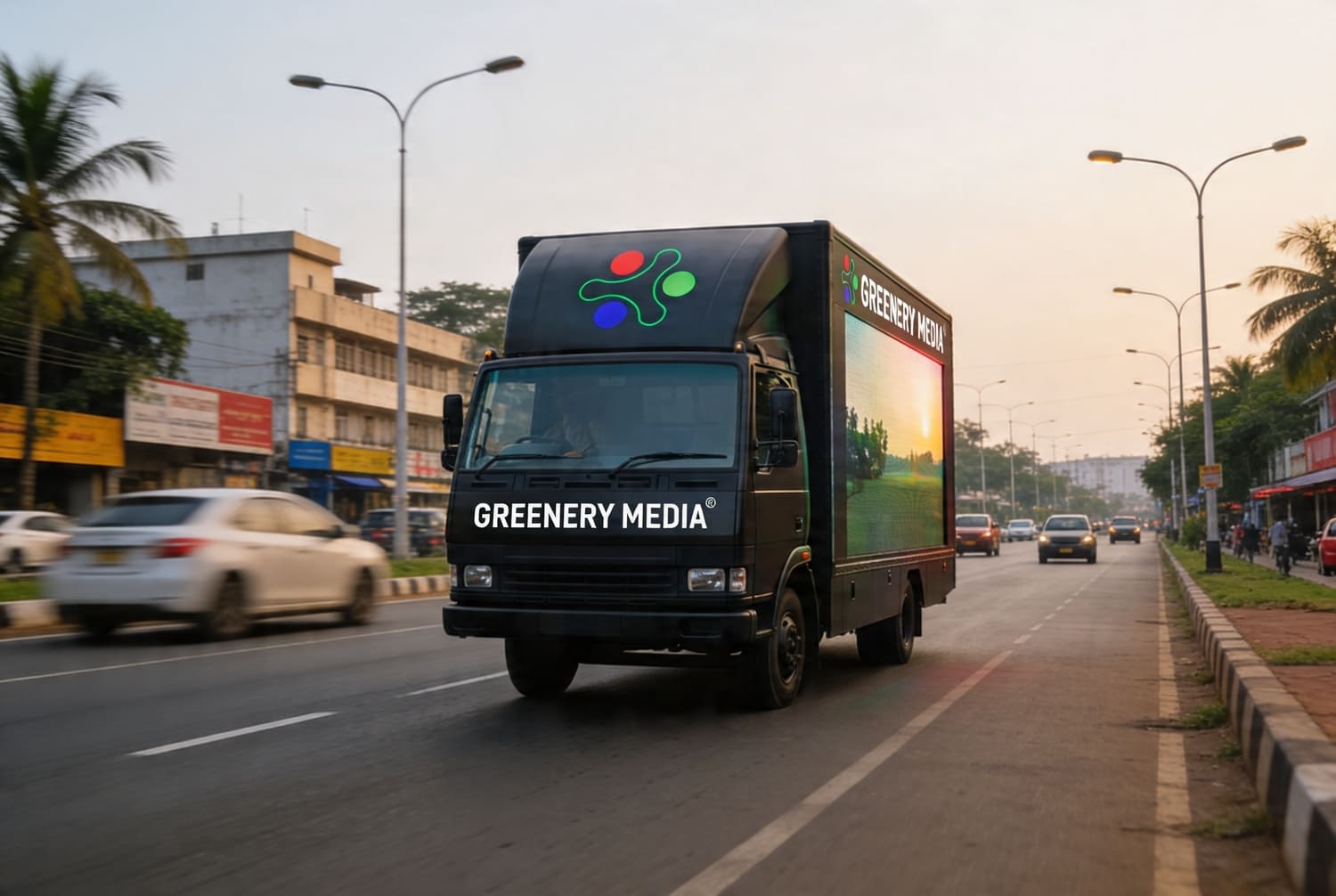
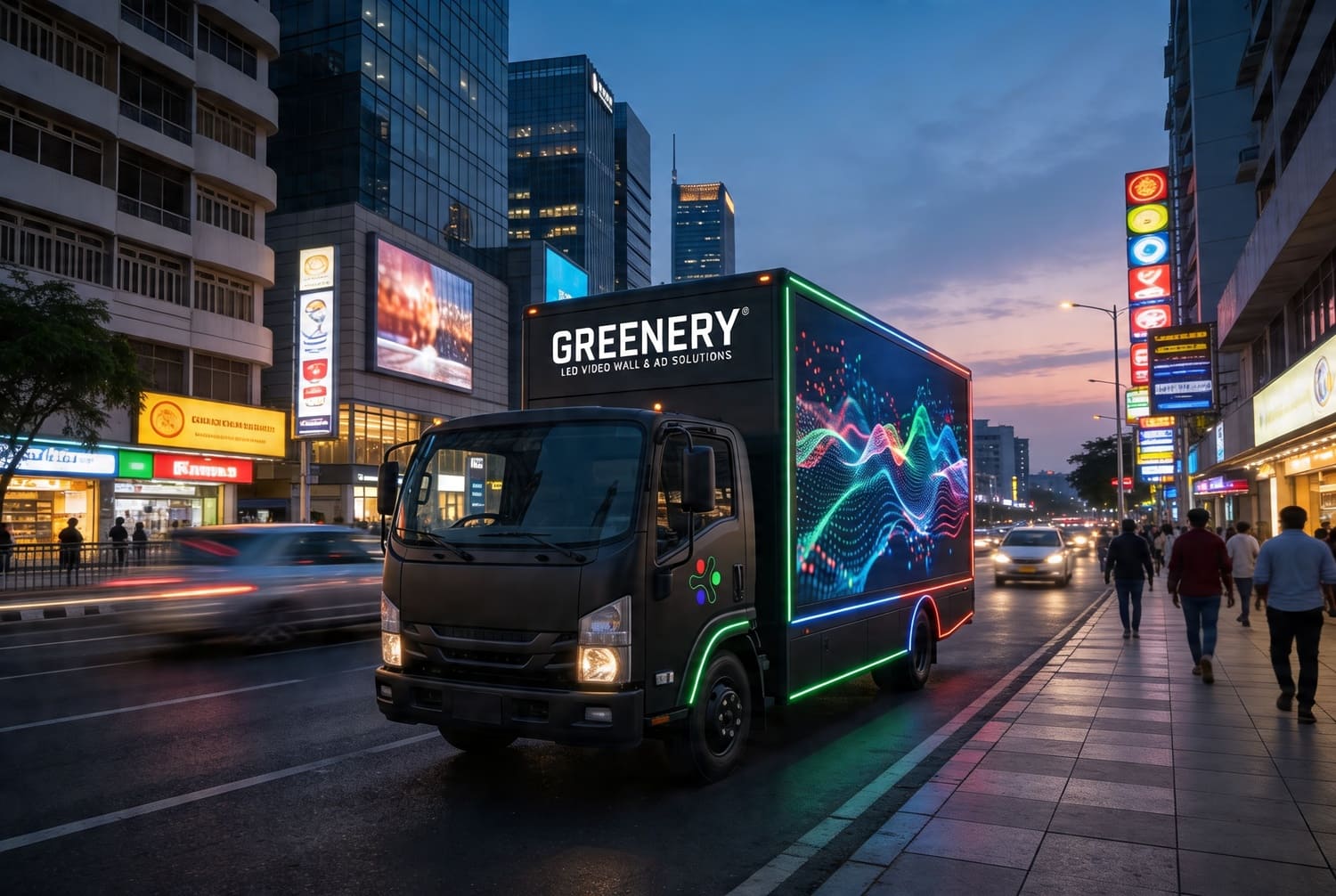
Kerala's urban advertising market is undergoing rapid digitisation. Major junction locations in Thiruvananthapuram, Kochi, and Kozhikode have seen significant installation of permanent LED billboard infrastructure over the past five years, with accelerating growth in secondary cities including Thrissur, Kollam, and Kannur. Simultaneously, the mobile LED van sector has expanded dramatically, with large fleet operators like Greenery Media providing dynamic DOOH coverage that reaches even the smallest towns and rural market centres across all 14 districts.
For brands seeking statewide outdoor LED presence in Kerala, the combination of permanent fixed-location digital billboards at major junctions and mobile LED van networks providing penetration into secondary and tertiary locations offers comprehensive geographic coverage that was simply not achievable through any previous OOH format.
Conclusion
Outdoor LED video walls represent the definitive evolution of OOH advertising — combining the physical, unskippable presence of traditional outdoor formats with the dynamic content capabilities, measurability, and strategic flexibility of digital media. As consumer attention becomes ever more fragmented across digital channels, the guaranteed physical presence of high-brightness outdoor LED advertising grows more strategically valuable, not less. Contact Greenery Media's OOH planning team today to design an outdoor LED campaign that maximises your brand's visibility across Kerala's most impactful locations.
Outdoor advertising has been a cornerstone of brand-building strategy for over a century — and yet it has never been more powerful, more measurable, or more visually arresting than it is today. The arrival of outdoor LED video wall technology has fundamentally transformed what Out-Of-Home advertising can achieve, enabling dynamic, high-brightness, full-motion visual campaigns that command attention on Kerala's busiest streets, highways, and public spaces. This comprehensive guide examines why outdoor LED video walls are not merely the future of OOH advertising — they are already its definitive present.
The Decline of Static OOH and the Rise of DOOH
Static flex hoardings and painted billboards dominated outdoor advertising in Kerala for generations. While they remain operational across the state, their strategic effectiveness is in sustained decline — and the reasons are structural rather than cyclical.
Consumer attention patterns have fundamentally changed. In an era where every individual carries a smartphone delivering a continuous stream of motion, colour, and dynamic media, the human brain has evolved new filtering mechanisms specifically designed to screen out static visual stimuli from familiar environments. The neighbourhood hoarding that a commuter passes every day for months becomes neurologically invisible — the visual cortex simply ceases to allocate processing resources to stimuli that have proven consistently unremarkable.
Digital Out-Of-Home advertising with LED technology directly addresses this fundamental challenge. Motion, colour change, and content novelty are the three primary environmental triggers that reliably interrupt the human brain's attentional filtering system. A high-brightness LED outdoor display cycling through dynamic video content exploits all three triggers simultaneously, every time a new animation frame appears.
Technical Superiority of LED in Outdoor Applications
Brightness: Competing With the Sun
The most fundamental technical requirement for outdoor LED advertising displays is brightness. In Kerala's equatorial climate, direct solar illuminance on a clear summer day can approach or exceed 100,000 lux. A display with insufficient brightness will appear dark and illegible, rendering the advertising investment worthless.
Professional outdoor LED panels for advertising applications produce 5,000 to 7,000 nits of brightness in standard configurations, with premium large-format billboard installations reaching 10,000 nits. This extraordinary luminance ensures the display maintains its full visual impact and legibility against even direct equatorial sunlight, at any time of day, in any season.
Automatic brightness sensors adjust panel output downward during overcast conditions or night operation, maintaining optimal visual appearance at all times while reducing power consumption during periods when full brightness is not required.
Weatherproofing for Kerala's Climate
Kerala's climate presents one of the most demanding weatherproofing challenges for outdoor electronic equipment in India. The state experiences intense monsoon rainfall — over 3,000mm annually in the Western Ghat foothills — combined with coastal salt spray, high ambient humidity throughout the year, and extreme temperature cycling between summer peaks of 38 to 40 degrees Celsius and cooler post-monsoon periods.
Professional outdoor LED advertising panels carry a minimum IP65 rating (completely sealed against dust and protected against water jets from any direction) and for coastal installations, IP66 or IP67 ratings provide additional security against high-pressure water ingress and temporary immersion, respectively.
Cabinet materials for outdoor LED advertising installations are typically marine-grade aluminium or stainless steel, with gasket-sealed access points and positive-pressure ventilation systems that prevent moisture ingress while managing the substantial heat generated by high-brightness LED operation in tropical ambient temperatures.
Content Flexibility
Digital content management is where outdoor LED video walls create their most substantial operational advantage over all competing OOH formats. Content updates on a digital LED billboard can be deployed in seconds through cloud-connected content management systems, enabling advertising strategies that were simply impossible in the era of static print and flex banners.
Multiple advertisers can share a single LED billboard through time-based content scheduling — something the OOH industry calls "share of voice" scheduling. A single outdoor LED installation can carry campaigns for 3 to 6 different advertisers in rotation within any given hour, dramatically improving the economic efficiency of the display asset and reducing effective CPM for each advertiser.
Strategic Advantages of Outdoor LED for Brand Building
Contextual Advertising Capability
The combination of real-time content management with location-based outdoor advertising creates the capability for contextual DOOH campaigns that were previously limited to digital online channels. An outdoor LED installation at a Kochi highway interchange can display a live cricket score update linking to a beverage brand sponsoring the match. A display at the entrance to a major shopping mall can promote a sale that ends in exactly the number of hours remaining on a live countdown timer. A food brand can switch its message from breakfast-appropriate to lunchtime-appropriate content at precisely 11:30 AM every day without any human intervention.
Integration With Mobile Advertising
One of the most powerful strategic developments in DOOH is physical-to-digital audience bridging. By installing geofences around outdoor LED display locations, mobile advertising networks can identify mobile device users who have been physically present in the display's viewshed area, then serve those users targeted mobile advertising that reinforces the outdoor campaign message.
This "OOH priming plus mobile retargeting" approach consistently generates engagement rates 2 to 4 times higher on the mobile component than equivalent mobile-only campaigns. The outdoor LED creates brand familiarity and primes the audience; the mobile follow-up converts that familiarity into direct action. Together, they create an integrated, attributable media funnel that operates across both the physical and digital worlds.
LED vs. Static OOH: A Head-to-Head Comparison
| Attribute | Static Hoarding | Outdoor LED |
|---|---|---|
| Attention capture | Low (static) | High (motion triggers) |
| Content update | Days (print + install) | Seconds (remote) |
| Multi-advertiser | No | Yes (scheduled rotation) |
| Night visibility | Requires external lighting | Self-luminous 24/7 |
| Environmental impact | High (print waste) | Low (digital, reusable) |
| Measurement | Traffic counts only | Plays, audience data, uplift studies |
The Kerala Outdoor LED Market
Kerala's urban advertising market is undergoing rapid digitisation. Major junction locations in Thiruvananthapuram, Kochi, and Kozhikode have seen significant installation of permanent LED billboard infrastructure over the past five years, with accelerating growth in secondary cities including Thrissur, Kollam, and Kannur. Simultaneously, the mobile LED van sector has expanded dramatically, with large fleet operators like Greenery Media providing dynamic DOOH coverage that reaches even the smallest towns and rural market centres across all 14 districts.
For brands seeking statewide outdoor LED presence in Kerala, the combination of permanent fixed-location digital billboards at major junctions and mobile LED van networks providing penetration into secondary and tertiary locations offers comprehensive geographic coverage that was simply not achievable through any previous OOH format.
Conclusion
Outdoor LED video walls represent the definitive evolution of OOH advertising — combining the physical, unskippable presence of traditional outdoor formats with the dynamic content capabilities, measurability, and strategic flexibility of digital media. As consumer attention becomes ever more fragmented across digital channels, the guaranteed physical presence of high-brightness outdoor LED advertising grows more strategically valuable, not less. Contact Greenery Media's OOH planning team today to design an outdoor LED campaign that maximises your brand's visibility across Kerala's most impactful locations.
Permanent vs. Temporary Outdoor LED Installations
Outdoor LED advertising infrastructure in Kerala spans two distinct installation models: permanent fixed structures and temporary event deployments. Understanding the different regulatory, structural, and operational requirements of each is essential for advertisers planning outdoor LED campaigns.
Permanent outdoor LED billboard installations require planning permission from the relevant local body — a panchayat, municipality, or corporation depending on the location — as well as where applicable from the National Highways Authority of India for placements adjacent to national highway corridors. The structural design of a permanent LED billboard must be certified by a licensed structural engineer, and the electrical installation must conform to relevant IS standards with periodic mandatory inspection. Operating licenses for commercial digital display advertising on public roads vary by state and are subject to local body ordinances regarding display size, brightness, and operational hours.
Temporary outdoor LED installations for specific events — concerts, festivals, political rallies, and trade exhibitions — operate under event-specific permits from the district administration and local body, typically combined with police permission for events in public spaces that may affect traffic or public order. The structural engineering certification requirements for temporary installations are typically less prescriptive than for permanent structures, but the fundamental obligation to ensure safe, wind-rated installation remains legally and morally non-negotiable.
Measuring the Effectiveness of Outdoor LED Campaigns
Measurement of outdoor LED advertising effectiveness has evolved significantly from the simplistic traffic count models that underpinned static OOH planning for decades. The following measurement approaches are being used by sophisticated DOOH advertisers in Kerala to build the evidence base for ongoing and growing OOH investment:
- Footfall analytics: Camera-based audience measurement systems attached to LED display structures count and profile pedestrian and vehicle traffic passing the display, providing actual audience exposure data rather than modelled estimates from road flow databases.
- Device-level audience profiling: Anonymised mobile device detection systems identify unique devices that pass within the display viewshed area, enabling demographic inference from device ownership data patterns and providing reach and frequency metrics at the location level.
- Sales correlation analysis: For retail and FMCG brands with good point-of-sale data, comparing sales volumes in campaign periods against equivalent non-campaign periods at stores within the display catchment area provides direct evidence of commercial impact.
- Brand tracking research: Regular brand awareness surveys among the target demographic in the campaign geography, conducted before, during, and after the campaign period, measure the shift in awareness and consideration attributable to the DOOH exposure.
Ready to Elevate Your Campaign?
Speak with our OOH media experts today. We provide full-service LED display rentals across Kerala and beyond.