Table of Contents
Choosing the right LED video wall for a corporate event can be the difference between a presentation that commands attention and one that fades into the background. With dozens of technical specifications to consider — pixel pitch, refresh rate, brightness, panel type — the process can feel overwhelming. This comprehensive guide breaks down every critical factor so you can confidently brief your AV provider and ensure your next corporate event in Kerala or anywhere across South India looks absolutely spectacular.
Why LED Video Walls Have Replaced Projectors at Corporate Events
It was not very long ago that a high-lumen projector and a stretched fabric screen was the gold standard for corporate presentations. Today, that setup looks dated, and for good reason. LED video walls offer a fundamentally superior viewing experience that projectors simply cannot match.
The most significant advantage is brightness. A professional projector in a well-lit conference hall might achieve 5,000 to 6,000 lumens, but ambient light from windows, stage lighting, and room overhead LEDs dramatically washes out the projected image. A fine-pitch indoor LED video wall, by contrast, operates at 800 to 1,500 nits of consistent brightness — a measurement far more relevant to display quality — and its emissive nature means the image glows from the screen rather than reflecting off it. The result is a vivid, pin-sharp image that looks immaculate whether the house lights are fully on or completely off.
Beyond brightness, LED walls offer seamless tiling. Unlike a projector setup where a single display chip covers the entire canvas, an LED wall is assembled from individual cabinet panels that lock together with no visible bezel or gap between them, creating a perfectly continuous image surface of virtually any size or shape.
Understanding Pixel Pitch: The Most Critical Specification
If there is one specification you must understand before renting or purchasing an LED video wall, it is pixel pitch. Pixel pitch is the distance — measured in millimetres — between the centre of one LED cluster (pixel) to the centre of the adjacent LED cluster. This single number determines the optimal viewing distance and the overall resolution density of the display.
Low Pixel Pitch (P1.5 – P2.9): Fine-Pitch Indoor Displays
Fine-pitch LED panels in the sub-3mm range are engineered for environments where the audience is relatively close to the screen — typically within 3 to 8 metres. These are the displays you see at high-end executive boardrooms, large-format video conference installations, broadcast studios, and premium product launch stages. At this pixel density, the image quality is indistinguishable from a direct-view LCD monitor even at close range.
The trade-off for this exceptional clarity is cost. Fine-pitch panels are the most expensive per-square-metre in the LED category. However, for a prestigious corporate launch where brand perception is everything, the investment is fully justified.
Mid Pixel Pitch (P3.0 – P4.8): The Sweet Spot for Most Corporate Events
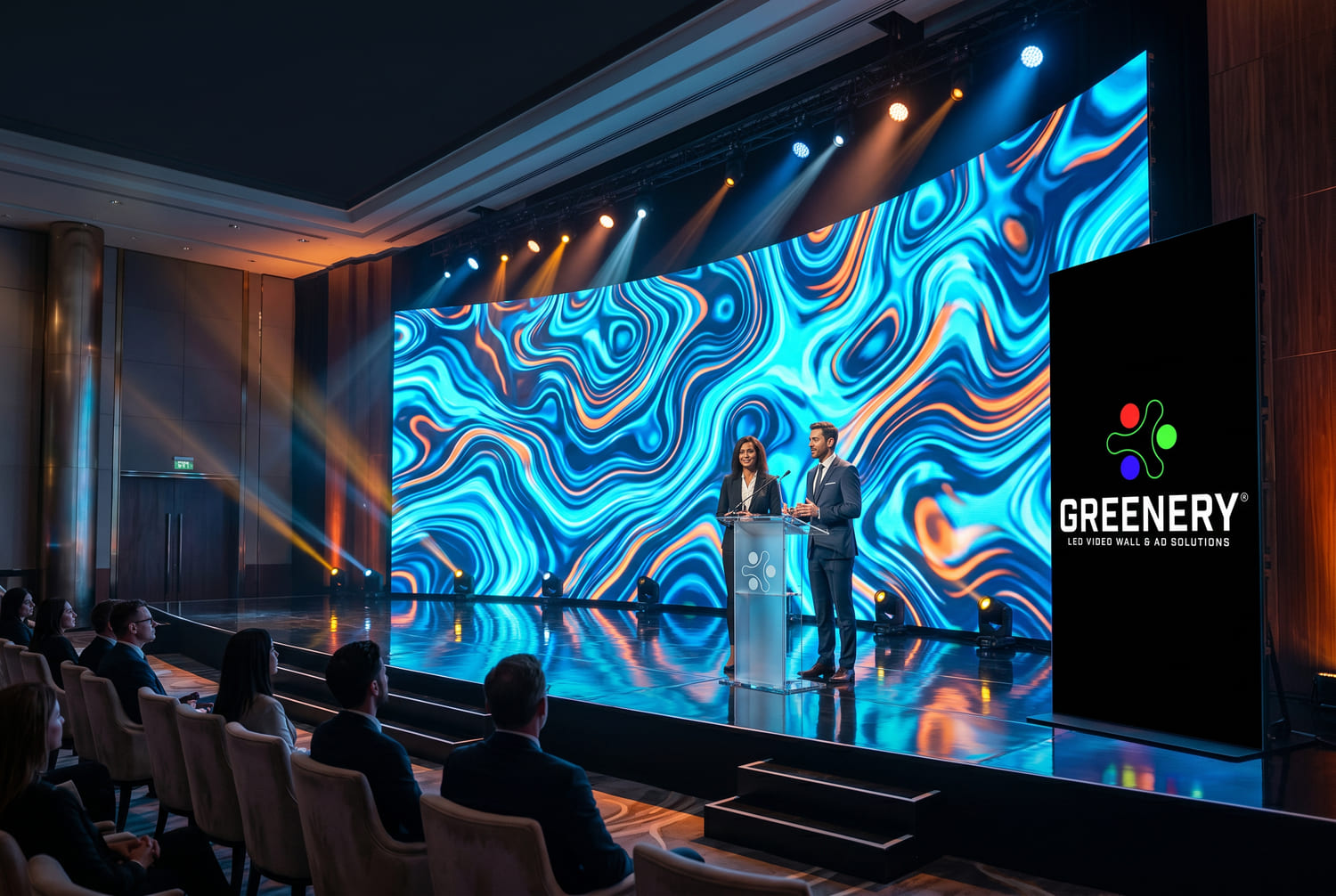
For the vast majority of corporate events — conferences with audiences of 200 to 2,000 people seated 5 to 20 metres from the stage — a P3.9 or P4.8 indoor LED panel delivers outstanding visual performance at a significantly lower rental cost than fine-pitch. This is the workhorse of the live event industry. You will find this specification deployed at annual general meetings, sales conferences, award ceremonies, product launches, and trade exhibition booths across South India.
High Pixel Pitch (P6 – P10): Outdoor and Long-Distance Applications
When your audience is viewing the screen from 15 metres or beyond — such as outdoor concerts, political rallies, stadium events, or large open-air festivals — a higher pixel pitch is both practical and cost-effective. The human eye cannot perceive individual pixels at these distances regardless of how small they are, so a P6 or P10 outdoor LED panel delivers excellent perceived image quality with far greater structural robustness and weather resistance.
Brightness and Nits: How Much Do You Really Need?
Brightness in LED displays is measured in nits (cd/m²). Understanding the right brightness level for your venue prevents overspending on panels that are brighter than necessary, or worse, renting under-powered displays that look dim on video content.
- 800–1,200 nits: Ideal for controlled indoor environments with dark or dimmed ambient lighting — theatre-style conference rooms, exhibition halls with managed lighting.
- 1,500–2,500 nits: Best for brightly lit indoor venues, large hotel ballrooms with chandelier lighting, or semi-outdoor covered spaces.
- 4,000–7,000 nits: Mandatory for direct outdoor exposure — roadshows, outdoor stages, parking lot activations, and any event under direct sunlight.
A common mistake event planners make is renting a standard indoor panel for a semi-outdoor corporate event at a hotel poolside or under a large open tent. Even diffused sunlight can reduce perceived brightness significantly, making your presentations look washed out and unprofessional.
Refresh Rate: Critical for Broadcasts and Photography
This specification is routinely overlooked by non-technical event planners, yet it is absolutely essential for events being photographed or live-streamed. Refresh rate describes how many times per second the display redraws its image, measured in Hertz (Hz).
Standard LED panels may operate at 960Hz or 1,920Hz. However, if your corporate event is being recorded for television broadcast, live-streamed online, or extensively photographed, you need panels with a refresh rate of at least 3,840Hz — and ideally above 7,680Hz. Below this threshold, camera sensors will capture dark banding or flickering across the LED screen, ruining otherwise perfectly shot footage. When briefing your LED rental provider in Kerala, specifically ask about the refresh rate of the panels being provided if media coverage is involved.
Screen Size and Viewing Angles: Getting the Geometry Right
A general industry rule of thumb for corporate events is that the screen width should be at least one-third the distance from the screen to the furthest viewer. So if your last row of seats is 30 metres from the stage, your screen should be a minimum of 10 metres wide. This ratio ensures everyone in the room can comfortably read text displayed on the screen without squinting.
Viewing angle is another specification worth understanding. Premium indoor LED panels typically offer a horizontal viewing angle of 160° and a vertical angle of 120°. This wide field of view ensures that even audience members seated at extreme side angles experience a consistent image without colour shift or brightness fall-off.
The Modular Advantage: Creative Screen Configurations
One of the most powerful — and underutilised — advantages of LED video walls is their modular, scalable nature. Unlike a fixed-size projector screen or flat-panel display, LED video walls can be assembled into an almost limitless variety of shapes, sizes, and configurations.
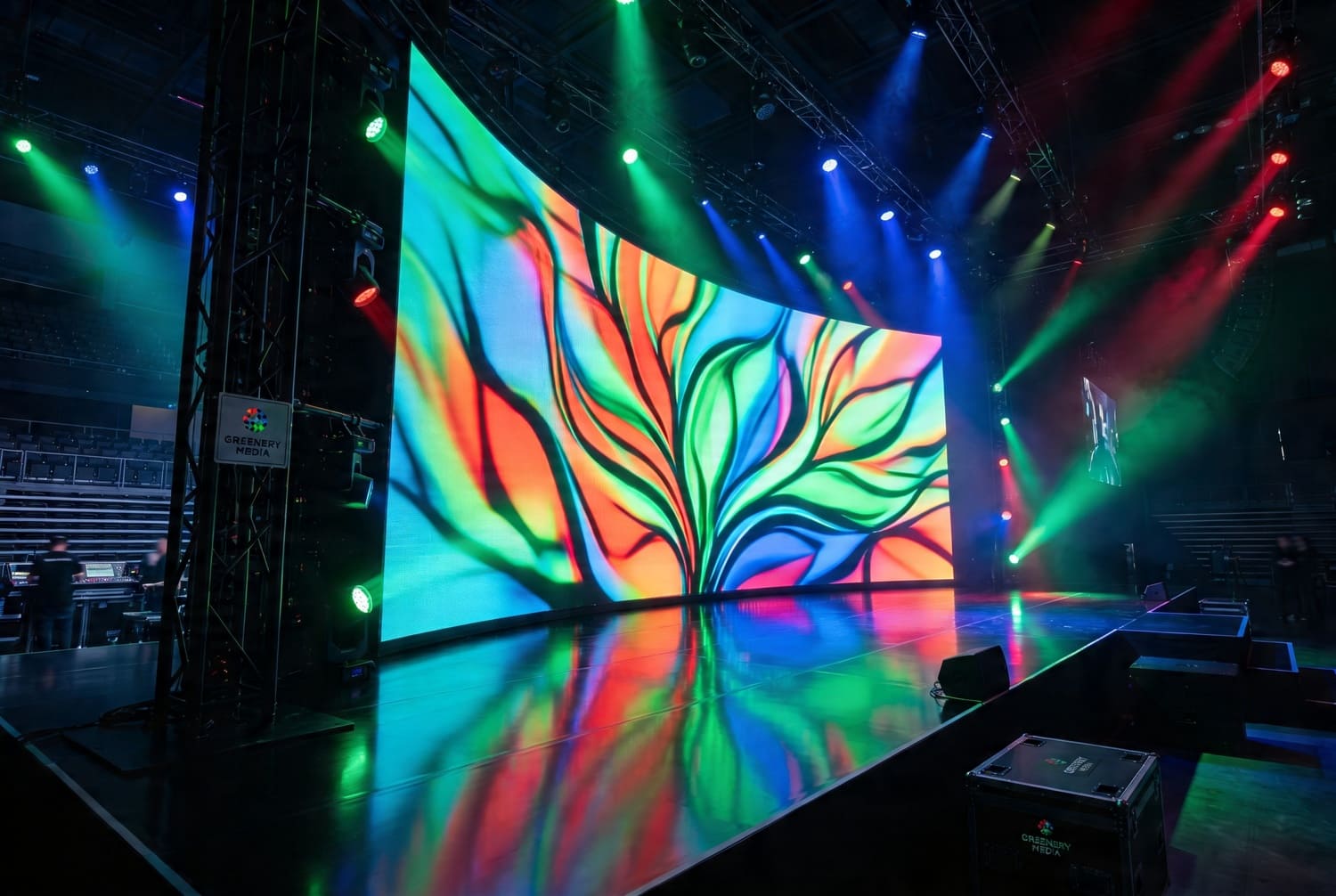
For a product launch stage, you could deploy a 12-metre wide curved concave wall that wraps around the presenter, creating an enveloping, immersive brand experience. For a trade exhibition booth, you might stack panels vertically to create a tall, attention-grabbing pillar display visible from across the exhibition hall. For an architectural installation at a corporate headquarters lobby, individual LED tiles can be mounted in non-rectangular patterns to create abstract visual sculptures.
This flexibility extends to multi-screen setups as well. A single media server can simultaneously drive a main stage screen, two side confidence monitors for the speakers, and additional breakout displays throughout the venue — all perfectly synchronised and managed from a single operator position.
Power, Cabling, and Structural Requirements
This is the area where many inexperienced event planners get caught off guard. A large LED video wall has significant power and structural requirements that your venue must be able to accommodate.
As a rough guide, standard indoor LED panels consume approximately 200 to 400 watts per square metre at full white brightness. A 40-square-metre stage backdrop wall might require 8 to 16 kilowatts of dedicated power — something to confirm with your venue's electrical team well in advance. Specialised cabling — high-speed CAT6 or optical fibre data cables — must be run from the media server or video switcher to each panel cabinet.
Structurally, a free-standing LED wall of significant size requires a ground-supported truss structure or a flown suspension rigging system, both of which must be engineered and certified to meet load-bearing and safety standards. Your experienced AV partner — like the team at Greenery Media — will handle all of these technical logistics, including liaison with the venue's structural and electrical teams.
Content Preparation: Optimising Your Visuals for LED
Even a world-class LED video wall will only look as good as the content fed into it. For LED walls, always prepare your creative assets at the native resolution of the assembled wall configuration. Work with your AV provider to obtain the exact pixel dimensions of the wall before beginning content production.
Key content guidelines for corporate LED displays:
- Use videos encoded at 50fps or 60fps for smooth motion. 24fps or 25fps can create visible judder on large LED walls.
- Avoid pure white backgrounds for speaker graphics — bright white causes glare that makes your speaker look washed out in photography.
- Use the DCI-P3 or sRGB colour profile when mastering your visuals — LED walls display these colour spaces far more accurately than older display technologies.
- Test all content on a physical LED panel — or at minimum a calibrated reference monitor — before the event day to identify any unexpected colour fringing or banding.
How to Evaluate Your LED Video Wall Rental Provider
Choosing the right technology is only half the equation. Partnering with a reliable, experienced LED display provider in Kerala is equally critical. Here are the key questions to ask any AV rental company before committing:
- How many panels of this specific model do you stock? Ensure they have sufficient quantity for your wall size plus 10–15% spares for redundancy.
- Do you provide on-site technical support for the full event duration? A dedicated LED technician should be present, not just available by phone.
- What is your panel replacement policy during an event? Panels can fail. A proven provider carries hot-swap spare cabinets that can be replaced in minutes.
- Can you provide references from similar corporate events? Ask specifically for events of comparable scale in a similar venue type.
Conclusion: Invest in the Right Visual Experience
Your corporate event is an investment — in your brand, in your relationships with clients and stakeholders, and in the morale and motivation of your team. The LED video wall is the centrepiece of that visual investment. Getting the specification right, from pixel pitch to refresh rate to structural configuration, ensures that every rupee you spend on the display delivers maximum return in terms of audience impact and brand perception.
At Greenery Media, our team of visual technology specialists has been helping corporate clients across Kerala and South India select, configure, and deploy LED video walls for over two decades. We carry extensive inventories of fine-pitch indoor panels, high-brightness outdoor displays, and everything in between — all managed and operated by our own trained technical crew. Contact us today for a detailed consultation and custom quote for your next corporate event.
Post-Event: Maintenance, De-Rig, and Sustainability
The event day is only one part of the LED display lifecycle on any project. After the event concludes, the LED wall must be safely de-rigged, packed down, and its panels inspected for any damage incurred during the event. A reliable provider will conduct a full panel audit within 24 hours of event completion and communicate any damage findings transparently.
From a sustainability standpoint, LED displays represent a dramatically more environmentally responsible choice than single-use printed flex banners. LED panels are durable, reusable assets that operate for 100,000+ hours of active life — across hundreds or thousands of events — before requiring significant maintenance. By choosing LED for your event, you are making the superior visual choice and the more environmentally responsible one, which matters increasingly to corporate stakeholders and event sustainability reporting frameworks.
Greenery Media carries comprehensive insurance coverage for all equipment deployed at client events, including public liability and equipment damage coverage, giving event organisers peace of mind that any unforeseen equipment incidents are professionally managed without financial exposure to the organising team.
Final Checklist for Corporate LED Wall Events
- Confirm pixel pitch based on minimum audience viewing distance from the stage.
- Specify refresh rate of at least 3,840Hz if the event will be photographed or recorded.
- Obtain the exact wall pixel dimensions before briefing content designers.
- Confirm venue power, access, and structural clearances at least four weeks before the event date.
- Schedule a technical rehearsal the day before to validate all content and signal routing.
- Confirm that a dedicated LED technician will be on-site for the full event duration with spare panel inventory.
Post-Event: Maintenance, De-Rig, and Sustainability
The event day is only one part of the LED display lifecycle on any project. After the event concludes, the LED wall must be safely de-rigged, packed down, and its panels inspected for any damage incurred during the event. A reliable provider will conduct a full panel audit within 24 hours of event completion and communicate any damage findings transparently.
From a sustainability standpoint, LED displays represent a dramatically more environmentally responsible choice than single-use printed flex banners. LED panels are durable, reusable assets that operate for 100,000+ hours of active life — across hundreds or thousands of events — before requiring significant maintenance. By choosing LED for your event, you are making the superior visual choice and the more environmentally responsible one, which matters increasingly to corporate stakeholders and event sustainability reporting frameworks.
Greenery Media carries comprehensive insurance coverage for all equipment deployed at client events, including public liability and equipment damage coverage, giving event organisers peace of mind that any unforeseen equipment incidents are professionally managed without financial exposure to the organising team.
Final Checklist for Corporate LED Wall Events
- Confirm pixel pitch based on minimum audience viewing distance from the stage.
- Specify refresh rate of at least 3,840Hz if the event will be photographed or recorded.
- Obtain the exact wall pixel dimensions before briefing content designers.
- Confirm venue power, access, and structural clearances at least four weeks before the event date.
- Schedule a technical rehearsal the day before to validate all content and signal routing.
- Confirm that a dedicated LED technician will be on-site for the full event duration with spare panel inventory.
Ready to Elevate Your Campaign?
Speak with our OOH media experts today. We provide full-service LED display rentals across Kerala and beyond.