Table of Contents
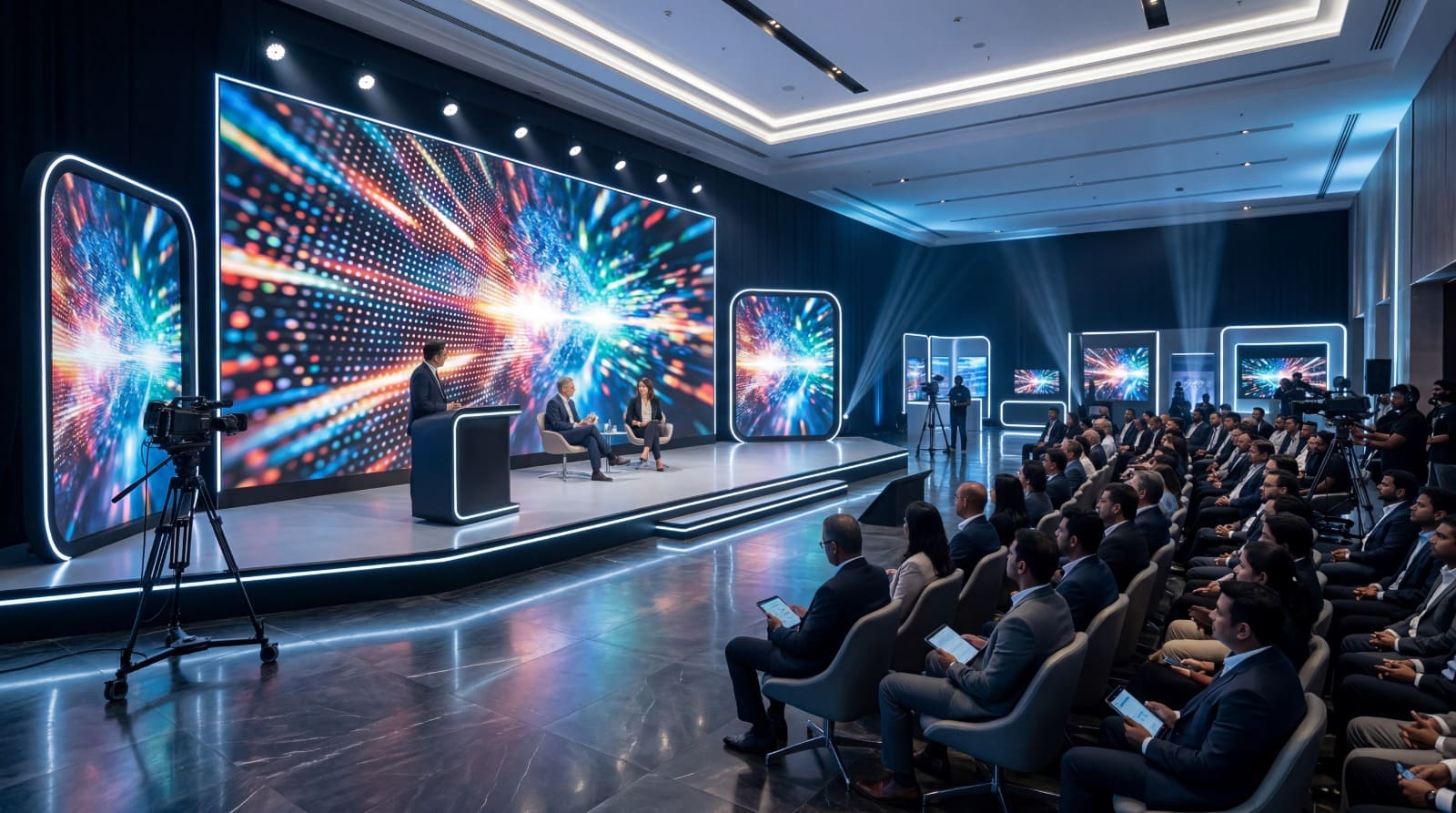
The era of projectors and printed flex backdrops is drawing to a close. Across South India's most prestigious corporate venues — from Kochi's five-star convention centres to Bengaluru's technology campus auditoriums — indoor LED video walls have become the defining visual technology of high-impact corporate events. This comprehensive guide explains precisely why, and how your organisation can harness this transformative technology to elevate every conference, product launch, and town hall you run.
The Corporate Event Landscape Is Changing
The bar for visual excellence at corporate events has risen dramatically in the past decade. A generation ago, a projector, a screen, and a printed roller banner behind the podium was perfectly acceptable for a senior leadership address or product launch. Today, that configuration signals a dated, low-investment event that fails to communicate brand seriousness.
The companies that consistently make the strongest impression at corporate events — whether at their annual general meetings, national sales conferences, or premium product launches — invest deliberately in visual production quality. And the centrepiece of that investment, without exception, is the LED video wall.
Why Indoor LED Video Walls Outperform Projectors
Brightness and Image Quality
A professional projector in a large conference hall delivers 6,000 to 8,000 lumens of brightness. This sounds impressive, but when this light is projected onto a white screen fabric and viewed in a room with stage lighting, ambient window light, and overhead fluorescents, the effective perceived brightness at the screen surface is dramatically reduced. The result is a washed-out image with desaturated colours and low contrast that makes reading detailed slides and watching video content genuinely difficult for the audience.
An indoor LED video wall panel producing 1,200 nits of brightness is an emissive display — meaning it generates its own light from the screen surface rather than reflecting projected light. This fundamental difference in display physics means that LED video walls maintain their full brightness and colour saturation regardless of ambient room lighting conditions. Switch all the house lights on, and the LED wall looks just as vivid and sharp as it does in darkness. This is not possible with any projection system.
Seamless Image Surface
Projection screens have edges, frames, and — in the case of blended multi-projector setups — visible blend zones where adjacent images overlap. LED video walls are assembled from individual cabinet panels that lock together with precision engineering, creating a completely seamless, continuous image surface of virtually any size. For logo reveals, full-screen photography, and brand video content, this seamless presentation is far more impressive and professional.
Viewing Angle Consistency
Projection screens have viewing angle limitations — audience members seated at extreme side angles often experience significant brightness and colour shift from the perpendicular. Indoor LED panels typically maintain consistent image quality across horizontal viewing angles of 140° to 160°, ensuring that delegates seated in the far corners of a large conference room see exactly the same image quality as those seated directly in front of the stage.
Key Specifications to Understand Before Booking
Pixel Pitch and Resolution
For indoor corporate events, the two most commonly deployed pixel pitch specifications are P3.9 (for standard conferences and presentations) and P2.9 (for premium launches and events with close-viewing audiences). A P3.9 panel has LED pixels spaced 3.9mm apart — this delivers excellent image quality for audiences seated more than 5 to 8 metres from the screen, covering virtually all standard corporate venue configurations. P2.9 panels offer higher resolution density suitable for audiences as close as 3 to 4 metres from the screen surface.
Refresh Rate for Photography and Video
If your corporate event will be photographed or filmed for any purpose — internal communications, media releases, social media content, or broadcast — you must specify panels with a high refresh rate. LED panels with a refresh rate below 3,840Hz will appear to flicker or show dark banding in photographs and video recordings. At 3,840Hz and above, the display captures cleanly in any camera. At 7,680Hz, even high-speed video captures are flicker-free. Always confirm this specification with your AV provider before your event.
Wall Size and Screen Ratio
LED video walls for corporate events are most commonly configured at standard 16:9 ratios for compatibility with PowerPoint and video content, or at ultra-wide 32:9 and 48:9 ratios for cinematic stage designs that use the additional width for ambient side-panel content around the central presentation window. Your AV provider will advise on the optimal configuration for your stage dimensions, audience size, and content format.
Planning Your Indoor LED Setup
Venue Assessment
Before confirming your LED wall specification, your AV provider should conduct a venue assessment covering floor load capacity (LED panels plus truss structure can be substantial), ceiling height (affecting how high the wall can fly or how tall a ground-supported structure can be), available power supply points and their amperage, and access logistics for delivering and assembling large LED cabinet units.
Integration With Lighting and Audio
LED video walls must be integrated with the overall event production design, particularly with stage lighting. Certain stage lighting fixtures — particularly those using older dimming technology — can introduce electrical interference that causes subtle image flickering on LED panels. Your AV provider should confirm that the lighting vendor's equipment is compatible with the LED display system being used.
Content Delivery and Management
For corporate presentations, the LED wall is typically driven by a combination of a media server (which manages video content, branding animations, and lower-third graphics), a presentation computer (running PowerPoint or Keynote), and a video switcher that routes multiple input sources to the appropriate zones of the display. A dedicated AV operator at the front-of-house position manages all switching and transitions during the event. This human element — experienced, trained LED operators — is as important as the technology itself.
Applications Across the Corporate Event Spectrum
- Annual General Meetings: Main stage LED installations combined with breakout gallery displays and LED confidence monitors for speakers, creating a cohesive, professional visual infrastructure across the entire event footprint.
- Product Launches: Premium product photography, film trailers, 3D renders, and technical specification visual content displayed at their best resolution and colour accuracy to drive maximum launch-day impact and social media coverage.
- National Sales Conferences: Large LED stages that create energetic, branded environments for motivational keynotes, regional recognition awards, and breakout session breakouts, maintaining brand consistency across a multi-day event.
- Training and Town Hall Meetings: Interactive display configurations where presentations, polls, live Q&A feeds, and real-time data dashboards are simultaneously managed on a large LED canvas for maximum audience engagement.
Conclusion
Indoor LED video walls are no longer a luxury reserved for the largest budgets in corporate events — they are increasingly the expected standard for any event where brand image and audience experience genuinely matter. With LED rental costs continuing to decrease as technology matures and production scale increases, the ROI case for upgrading from projection to LED is now compelling at virtually every event scale.
Greenery Media's indoor LED rental inventory spans fine-pitch P1.9 panels through to event-standard P3.9 and P4.8 configurations, with complete technical production services including media servers, video switching, and experienced on-site operators. Contact our corporate events team for a full technical proposal for your next event in Kerala or anywhere across South India.
The era of projectors and printed flex backdrops is drawing to a close. Across South India's most prestigious corporate venues — from Kochi's five-star convention centres to Bengaluru's technology campus auditoriums — indoor LED video walls have become the defining visual technology of high-impact corporate events. This comprehensive guide explains precisely why, and how your organisation can harness this transformative technology to elevate every conference, product launch, and town hall you run.
The Corporate Event Landscape Is Changing
The bar for visual excellence at corporate events has risen dramatically in the past decade. A generation ago, a projector, a screen, and a printed roller banner behind the podium was perfectly acceptable for a senior leadership address or product launch. Today, that configuration signals a dated, low-investment event that fails to communicate brand seriousness.
The companies that consistently make the strongest impression at corporate events — whether at their annual general meetings, national sales conferences, or premium product launches — invest deliberately in visual production quality. And the centrepiece of that investment, without exception, is the LED video wall.
Why Indoor LED Video Walls Outperform Projectors
Brightness and Image Quality
A professional projector in a large conference hall delivers 6,000 to 8,000 lumens of brightness. This sounds impressive, but when this light is projected onto a white screen fabric and viewed in a room with stage lighting, ambient window light, and overhead fluorescents, the effective perceived brightness at the screen surface is dramatically reduced. The result is a washed-out image with desaturated colours and low contrast that makes reading detailed slides and watching video content genuinely difficult for the audience.
An indoor LED video wall panel producing 1,200 nits of brightness is an emissive display — meaning it generates its own light from the screen surface rather than reflecting projected light. This fundamental difference in display physics means that LED video walls maintain their full brightness and colour saturation regardless of ambient room lighting conditions. Switch all the house lights on, and the LED wall looks just as vivid and sharp as it does in darkness. This is not possible with any projection system.
Seamless Image Surface
Projection screens have edges, frames, and — in the case of blended multi-projector setups — visible blend zones where adjacent images overlap. LED video walls are assembled from individual cabinet panels that lock together with precision engineering, creating a completely seamless, continuous image surface of virtually any size. For logo reveals, full-screen photography, and brand video content, this seamless presentation is far more impressive and professional.
Viewing Angle Consistency
Projection screens have viewing angle limitations — audience members seated at extreme side angles often experience significant brightness and colour shift from the perpendicular. Indoor LED panels typically maintain consistent image quality across horizontal viewing angles of 140° to 160°, ensuring that delegates seated in the far corners of a large conference room see exactly the same image quality as those seated directly in front of the stage.
Key Specifications to Understand Before Booking
Pixel Pitch and Resolution
For indoor corporate events, the two most commonly deployed pixel pitch specifications are P3.9 (for standard conferences and presentations) and P2.9 (for premium launches and events with close-viewing audiences). A P3.9 panel has LED pixels spaced 3.9mm apart — this delivers excellent image quality for audiences seated more than 5 to 8 metres from the screen, covering virtually all standard corporate venue configurations. P2.9 panels offer higher resolution density suitable for audiences as close as 3 to 4 metres from the screen surface.
Refresh Rate for Photography and Video
If your corporate event will be photographed or filmed for any purpose — internal communications, media releases, social media content, or broadcast — you must specify panels with a high refresh rate. LED panels with a refresh rate below 3,840Hz will appear to flicker or show dark banding in photographs and video recordings. At 3,840Hz and above, the display captures cleanly in any camera. At 7,680Hz, even high-speed video captures are flicker-free. Always confirm this specification with your AV provider before your event.
Wall Size and Screen Ratio
LED video walls for corporate events are most commonly configured at standard 16:9 ratios for compatibility with PowerPoint and video content, or at ultra-wide 32:9 and 48:9 ratios for cinematic stage designs that use the additional width for ambient side-panel content around the central presentation window. Your AV provider will advise on the optimal configuration for your stage dimensions, audience size, and content format.
Planning Your Indoor LED Setup
Venue Assessment
Before confirming your LED wall specification, your AV provider should conduct a venue assessment covering floor load capacity (LED panels plus truss structure can be substantial), ceiling height (affecting how high the wall can fly or how tall a ground-supported structure can be), available power supply points and their amperage, and access logistics for delivering and assembling large LED cabinet units.
Integration With Lighting and Audio
LED video walls must be integrated with the overall event production design, particularly with stage lighting. Certain stage lighting fixtures — particularly those using older dimming technology — can introduce electrical interference that causes subtle image flickering on LED panels. Your AV provider should confirm that the lighting vendor's equipment is compatible with the LED display system being used.
Content Delivery and Management
For corporate presentations, the LED wall is typically driven by a combination of a media server (which manages video content, branding animations, and lower-third graphics), a presentation computer (running PowerPoint or Keynote), and a video switcher that routes multiple input sources to the appropriate zones of the display. A dedicated AV operator at the front-of-house position manages all switching and transitions during the event. This human element — experienced, trained LED operators — is as important as the technology itself.
Applications Across the Corporate Event Spectrum
- Annual General Meetings: Main stage LED installations combined with breakout gallery displays and LED confidence monitors for speakers, creating a cohesive, professional visual infrastructure across the entire event footprint.
- Product Launches: Premium product photography, film trailers, 3D renders, and technical specification visual content displayed at their best resolution and colour accuracy to drive maximum launch-day impact and social media coverage.
- National Sales Conferences: Large LED stages that create energetic, branded environments for motivational keynotes, regional recognition awards, and breakout session breakouts, maintaining brand consistency across a multi-day event.
- Training and Town Hall Meetings: Interactive display configurations where presentations, polls, live Q&A feeds, and real-time data dashboards are simultaneously managed on a large LED canvas for maximum audience engagement.
Conclusion
Indoor LED video walls are no longer a luxury reserved for the largest budgets in corporate events — they are increasingly the expected standard for any event where brand image and audience experience genuinely matter. With LED rental costs continuing to decrease as technology matures and production scale increases, the ROI case for upgrading from projection to LED is now compelling at virtually every event scale.
Greenery Media's indoor LED rental inventory spans fine-pitch P1.9 panels through to event-standard P3.9 and P4.8 configurations, with complete technical production services including media servers, video switching, and experienced on-site operators. Contact our corporate events team for a full technical proposal for your next event in Kerala or anywhere across South India.
Troubleshooting Common LED Video Wall Issues at Corporate Events
Even with the most thorough pre-event planning and preparation, live events present unexpected technical challenges. Understanding the most common LED display issues and how experienced providers address them helps event planners develop realistic contingency expectations and make informed decisions when under pressure during an event.
The most frequently encountered issue at corporate LED deployments is signal loss between the presentation computer and the LED wall processor. This is typically caused by a loose HDMI or DisplayPort connection, a driver compatibility issue between the laptop and the video switcher, or a resolution mismatch between the presentation computer output and the expected input specification of the media server. An experienced LED operator will resolve most signal issues within 60 to 90 seconds through a practiced troubleshooting sequence. Event planners should build at least 15 minutes of buffer before any critical on-stage moment to allow for pre-show technical checks that catch these issues before they arise during the live program.
A second common issue is individual LED panel or module failure during the event. Modern LED panels are modular at the component level — individual LED modules within a cabinet can be swapped in minutes by a trained technician. A pixel-perfect repair that is invisible to the audience is achievable during natural program breaks. Greenery Media's on-site technicians carry full spare module inventories for every event deployment, ensuring that any panel element failure can be addressed rapidly without event disruption.
Colour calibration drift — where individual panels display subtly different colour temperature or brightness than their neighbours — can manifest in long-running LED deployments exposed to significant temperature changes (for example, an LED wall that has been running at full brightness for 6+ hours in a warm venue). This issue is prevented through a calibration verification check conducted by the technical team at the start of each event day and at major program breaks. Premium LED panels from established manufacturers include automated calibration management systems that actively compensate for thermal drift, maintaining consistent appearance across the entire wall surface.
The ROI Case: LED vs. Projector for Corporate Events
When corporate event managers first encounter the rental cost of a professional indoor LED video wall versus a comparable projector system, the initial reaction is often sticker shock. A P3.9 indoor LED wall rental for a 500-person conference commands a premium over an equivalent projector setup. Understanding where this premium delivers genuine return is essential to justifying the investment.
The most compelling ROI argument for LED over projection at corporate events is the accumulated impact on event photography, which in the digital age is one of the primary deliverables of any corporate gathering. Professional event photography shot against a bright, detail-rich, dynamic LED backdrop consistently produces images that are markedly superior to those taken against a washed-out projection screen. These photographs go onto corporate LinkedIn pages, annual reports, press releases, and internal communications — and the impression of visual excellence they communicate has measurable brand value that persists long after the event itself.
A second ROI dimension is attendee experience and satisfaction ratings. In post-event surveys across comparable events using projection versus LED video walls, attendees consistently rate LED-backed events as higher quality, more professional, and more impressive — even when the event content, speaker quality, and other production elements are identical. This perception of event quality has tangible downstream effects on brand perception, particularly for client-facing and investor-facing events where impression management is a primary objective.
Ready to Elevate Your Campaign?
Speak with our OOH media experts today. We provide full-service LED display rentals across Kerala and beyond.